Mr. Saganishiki now has a new web site:
http://www.saganishiki117.sakura.ne.jp/index.html
Sorry but only in Japanese.
Friday, July 5, 2013

Wednesday, February 8, 2012
Saganishiki School
Izumi: Graduate School of Traditional Arts and Crafts. School near Tokyo that offers a graduate degree in three of the traditional arts and crafts: lacquer, brocade weaving and Saganishiki.
The school is for developmentally disabled and autistic individuals.
Please visit their website: http://homepage2.nifty.com\aisenkai
The school is for developmentally disabled and autistic individuals.
Please visit their website: http://homepage2.nifty.com\aisenkai
Sunday, April 17, 2011
Kurume kasuri
 Visited a master of Kurume kasuri in October. This is the studio of Tetsuya Matsueda. He is the fifth generation of this art. His grandfather became famous for developing a technique of shading the indigo in his designs.
Matsueda-san won an Award of Excellence at the 2010 Exhibition of Japanese Traditional Crafts Art.
 An example of Kurume kasuri, splash design.
 Pattern being applied to the white cotton thread.
 Inked pattern now wrapped with linen as a resist.
 Indigo dyepots.
 Dyed thread woven with splash design.
Moyoori

Learning the moyoori technique of Saganishiki.
Required learning how to graph the design and transfer that pattern into each woven row. Still at the beginning of the process but learning through my mistakes.
Thursday, July 8, 2010
Saganishiki history is fairly recent compared to many of the famous Japanese weaving techniques.
It has similarities to nishiki, woven brocade. However, there is no supplemental warp with Saganishiki.
A search of the literature reveals a multitude of entries referencing the origination of the art. It was developed by the Nabeshima clan who, unfortunately, kept it secret. There was no sharing of this technique nor written history.
It is a history that has been passed down, and thus modified, as that information was exchanged.
Saganishiki was created by the Nabeshima clan around 1800 in Kashima, Saga Prefecture, Kyushu Island.
Princess Kashioka was ill and confined to her bed. She would gaze at the ceiling and asked if the ceiling design could be woven.
One of her attendants, born in Kyoto, used a paper weaving technique to recreate the ceiling design. The weaving was kept secret by the Nabeshima clan so that it could not be copied.
The first design was ajiori, a wicker pattern using paper for the warp and weft. As experience progressed, the warp remained paper but the weft was changed to silk thread.
The weaving technique waned over the years. Many members of the Nabeshima clan began to move away from Kashima in search of employment. With them, went the knowledge of the technique.
The Meiji restoration brought Japan out of the feudal era and improved the political and social structure. The Emperor Meiji revitalized the occupation of weaving. Saganishiki also began to acquire new interest and scope beyond the Nabeshima.
The greatest resurgence of Saganishiki occurred with the 1910 Japan-British Exposition in London. In order to get some recognition of his hometown Prefecture Saga, Shigenobu Okuma, a former Prime Minister, facilitated the entry of a piece of Saganishiki woven by Sagara Yoshiko. He had the weaving renamed Saganishiki to reflect Saga Prefecture. Kashima, the origination of the weave is a town in Saga Prefecture.
It has similarities to nishiki, woven brocade. However, there is no supplemental warp with Saganishiki.
A search of the literature reveals a multitude of entries referencing the origination of the art. It was developed by the Nabeshima clan who, unfortunately, kept it secret. There was no sharing of this technique nor written history.
It is a history that has been passed down, and thus modified, as that information was exchanged.
Saganishiki was created by the Nabeshima clan around 1800 in Kashima, Saga Prefecture, Kyushu Island.
Princess Kashioka was ill and confined to her bed. She would gaze at the ceiling and asked if the ceiling design could be woven.
One of her attendants, born in Kyoto, used a paper weaving technique to recreate the ceiling design. The weaving was kept secret by the Nabeshima clan so that it could not be copied.
The first design was ajiori, a wicker pattern using paper for the warp and weft. As experience progressed, the warp remained paper but the weft was changed to silk thread.
The weaving technique waned over the years. Many members of the Nabeshima clan began to move away from Kashima in search of employment. With them, went the knowledge of the technique.
The Meiji restoration brought Japan out of the feudal era and improved the political and social structure. The Emperor Meiji revitalized the occupation of weaving. Saganishiki also began to acquire new interest and scope beyond the Nabeshima.
The greatest resurgence of Saganishiki occurred with the 1910 Japan-British Exposition in London. In order to get some recognition of his hometown Prefecture Saga, Shigenobu Okuma, a former Prime Minister, facilitated the entry of a piece of Saganishiki woven by Sagara Yoshiko. He had the weaving renamed Saganishiki to reflect Saga Prefecture. Kashima, the origination of the weave is a town in Saga Prefecture.
Wednesday, June 23, 2010

Japan May 2010
One of my stops this trip was to meet Bryan Whitehead. Bryan is living every fiber artists dream.
He had been living in Japan for the past 25 years in a very old traditional Japanese farmhouse.
Pictured here in his shop in the Fujino town center, Bryan demonstrates backstrap weaving.
 Bryan raises his own indigo and prepares the leaves in the traditional Japanese method of fermentation. He maintains an indigo dyebath at both the shop and house.
Of special note, he raises his own silkworms, then reels, dyes and weaves the silk.
Dyeing includes the indigo as well as other natural dyeing vegetation.
Please visit his website: www.japanesetextileworkshops.blogspot.com/
Wednesday, June 16, 2010
Japan, May 2010
Recently returned to Japan for more lessons and shopping.
Spent a few days in Tokyo purchasing Saganishiki thread and warp paper. Also visited a number of shops that sell accessories.
Lessons focused on Moyoori this visit. Very complicated and most went over my head. I like the technique and want to continue. I prefer combining design with pattern.
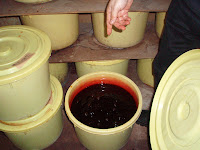 While in Kyushu, visited Akizuki to observe the use of the cherry tree in the making of a pink dye. Mr. Yasuhisa Komuro claims he is the only dyer who has had success making the pink color from the cherry tree. It takes 3 months to make the dye using select parts of the cherry tree. Three colors can be obtained: beige, orange and pink.


Recently returned to Japan for more lessons and shopping.
Spent a few days in Tokyo purchasing Saganishiki thread and warp paper. Also visited a number of shops that sell accessories.
Lessons focused on Moyoori this visit. Very complicated and most went over my head. I like the technique and want to continue. I prefer combining design with pattern.
 While in Kyushu, visited Akizuki to observe the use of the cherry tree in the making of a pink dye. Mr. Yasuhisa Komuro claims he is the only dyer who has had success making the pink color from the cherry tree. It takes 3 months to make the dye using select parts of the cherry tree. Three colors can be obtained: beige, orange and pink.

Subscribe to:
Posts (Atom)


